

Why the Green Card Matters

For millions of people, a Green Card is more than just a piece of plastic. It’s proof of lawful permanent residence. It means you can live and work freely in the United States, travel in and out more easily, and, after a few years, apply for U.S. citizenship. Families are reunited through it. Careers are built on it. For many, it’s the step from uncertainty to stability.

But getting one is not simple. U.S. immigration law is layered with categories, quotas, wait times, and legal requirements. Let’s break it down in plain language so you know exactly what’s out there and what might apply to you.

What Is a Green Card?

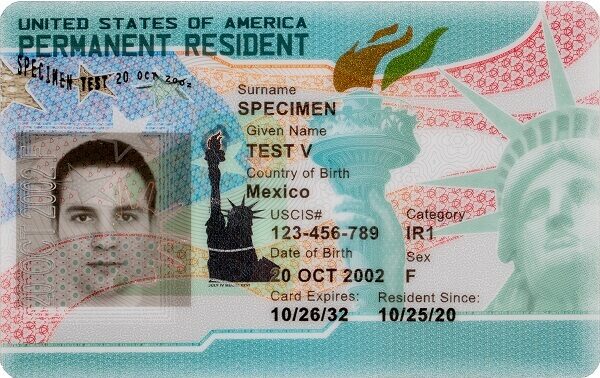
A Green Card is the common name for the Lawful Permanent Resident Card. It gives you the right to live and work in the U.S. on a permanent basis. You don’t become a citizen right away, but you’re much closer to it. Green Card holders can sponsor certain family members, travel more freely, and enjoy many of the protections U.S. citizens have.

Key takeaway: Green Card = permanent resident status. Not temporary. Not a work permit. A long-term solution.

A sample of a Green Card, also called a Permanent Resident Card
source: citizenpath.com/how-to-read-green-card/

Pathways to a Green Card

There isn’t just one way to get a Green Card. The U.S. immigration system recognizes different relationships, skills, and circumstances. Here are the major categories:

  1. Family-Based Green Cards
  • Immediate Relatives of U.S. Citizens (spouses, unmarried children under 21, and parents). These are the fastest-moving cases, with no yearly quotas.
  • Other Family Members: Includes siblings of U.S. citizens, married children, and spouses/unmarried children of Green Card holders. These fall into the “family preference categories” and usually involve long waits, sometimes years, depending on the applicant’s home country.

Current wait times (2025): Marriage-based Green Cards for spouses of U.S. citizens average about 9 to 14 months, while spouses of permanent residents can wait closer to 3 years.

  1. Employment-Based Green Cards

If you’re in the U.S. working on a temporary visa (like H-1B, L-1, or O-1), an employment-based Green Card could be your path.

  • EB-1: For priority workers (multinational executives, top researchers, or people with extraordinary ability).
  • EB-2: Professionals with advanced degrees or exceptional ability.
  • EB-3: Skilled workers, professionals, and even some unskilled workers.
  • EB-4: Certain special immigrants (religious workers, U.S. government employees abroad, etc.).
  • EB-5: Investors who put at least $800,000 to $1,050,000 into U.S. businesses creating jobs.

Current context (2025): Employer-sponsored Green Cards now take about 3.4 years on average to process, the longest in U.S. history. Backlogs, especially for applicants from India and China, remain severe.

  1. Humanitarian Green Cards

The U.S. also grants permanent residence on humanitarian grounds.

  • Refugees and Asylees: Eligible for a Green Card one year after being granted asylum or refugee status.
  • Victims of Crime or Trafficking (U Visa or T Visa holders): May apply for a Green Card after meeting certain conditions.
  • VAWA Applicants: For survivors of domestic violence who are spouses, children, or parents of U.S. citizens or Green Card holders.
  1. Diversity Visa Lottery

Every year, the U.S. runs the Diversity Visa (DV) Lottery, giving 55,000 people from underrepresented countries the chance to apply for a Green Card. It’s luck-based, but still one of the fastest options if selected.

  1. Other Green Card Categories
  • Registry: Available to people who have lived continuously in the U.S. since before Jan 1, 1972.
  • Special programs: Certain Afghan and Iraqi nationals who worked with the U.S. government, Cuban Adjustment Act, etc.

The Two Main Processes to Apply

No matter what category you fall under, there are only two ways to actually apply for your Green Card:

  1. Adjustment of Status (Form I-485): If you are already inside the U.S. on a valid visa.
  2. Consular Processing: If you are outside the U.S. and need to go through your local U.S. consulate or embassy.

Both involve biometrics, medical exams, background checks, and interviews.

The Current Reality (2025)

Here’s the truth: Green Cards are taking longer than ever.

  • Family-based applications range from 9 months to 3 years.
  • Employer-sponsored Green Cards average 3.4 years.
  • Some categories, like EB-2 and EB-3 for Indians and Chinese, can stretch into a decade-long wait.

Despite the delays, securing a Green Card remains the single most stable and rewarding step for immigrants in the U.S.

Frequently Asked Question to Us

Question: How do I know if I qualify for a Green Card?
TheImmiQuest: Check your ties through family, work, or humanitarian eligibility. Almost every Green Card category falls into one of these three buckets.

Question: Which is faster, Adjustment of Status or Consular Processing?
TheImmiQuest: It depends. Adjustment of Status lets you stay in the U.S., while Consular Processing is done abroad. Timing can vary depending on category and location.

Question: Can I travel while my Green Card application is pending?
TheImmiQuest: Only with an approved Advance Parole document. Leaving the U.S. without it may affect your application.

How to Get a Green Card

Getting a U.S. Green Card means permanent residency. You can get one through family, employment, humanitarian reasons, or the diversity lottery. The steps below explain the general process without giving personalized legal guidance.

Step-by-step breakdown

  1. Step 1: Determine Your Eligibility Category
    • Family-based: If you have a close relative who is a U.S. citizen or Green Card holder.
    • Employment-based: If you have a qualifying job offer or work visa.
    • Humanitarian: Refugees, asylees, or certain crime/abuse victims may be eligible.
    • Diversity Visa Lottery: Individuals from eligible countries may qualify if selected.

Question: “Can I qualify in more than one way?”
TheImmiQuest: Yes, it’s possible to qualify through more than one pathway, depending on your situation. For example, someone who is a spouse might also be eligible for relief through an employer-based route or a U visa, if applicable. In these cases, it’s important to explore all available options to determine which one might be the fastest and most reliable.

Step 2: Understand the Path to Apply (Adjustment of Status (AOS) or Consular Processing (CP)

  • Adjustment of Status (AOS): For individuals already in the U.S. on a valid visa. May allow work authorization and travel permission through Advance Parole.
  • Consular Processing (CP): For individuals outside the U.S. who will apply through a U.S. consulate or embassy.

Note: Choosing a path depends on your situation and eligibility; consult official USCIS guidance for your category.

Step 3: Filing required petitions:

  • Family-based: Petitioned by a U.S. citizen or Green Card holder relative using Form I-130.
  • Employment-based: Employer may file Form I-140, sometimes after labor certification.
  • Humanitarian: Relevant petitions include Form I-360 for VAWA/SIJ or I-485 for asylees/refugees.


Important: Submission requirements, fees, and supporting documents vary by category and case.

Step 4: Submitting your Green Card application:

  • In the U.S.: Form I-485 with biometrics, medical exam, proof of financial support, and other required documents.
  • Abroad: Form DS-260, consular interview, medical exam, and police certificates.

Step 5: Prepare for the Interview:

    • Bring all original documents relevant to your petition.
    • Family-based cases: Proof of relationship, joint financial documents, photos, affidavits, etc.
    • Employment-based cases: Proof of ongoing qualifying employment.
    • Humanitarian cases: Relevant approvals, protection documents, and supporting evidence.

Tip: Always check the official USCIS instructions for the most current guidance.

Step 5: Approval and next steps:

  • After approval, a Green Card is issued. Conditional Green Cards (marriages under two years) require filing Form I-751 to remove conditions within the allowed period.
  • Maintaining lawful status, keeping documents organized, and monitoring USCIS updates are essential throughout the process. 


Takeaway
Getting a Green Card is a multi-stage journey. The key is to understand the different paths, submit applications when eligible, keep documents organized, and monitor the Visa Bulletin if applicable. Professionals like TheImmiQuest can provide guidance and resources to help applicants navigate the process efficiently.

Getting a Family-Based Green Card

Why it matters
Family means everything. And U.S. immigration values family ties. If you’re married to a U.S. citizen or related in certain ways, you’re at the front of the Green Card line.

Key categories

  • Immediate relatives of U.S. citizens: spouse, unmarried child under 21, parent (U.S. citizen must be 21+). No annual cap – these are the fastest lanes.
  • Family preference categories: siblings, married children of U.S. citizens, and spouses or unmarried children of Green Card holders. These categories are subject to annual caps, so waiting times vary.

Process breakdown

  1. File the I-130
    • Submit supporting documentation like birth or marriage certificates, proof of your relative’s U.S. status, and evidence of a bona fide relationship (photos, correspondence, affidavits).
  2. Check the Visa Bulletin (if not an immediate relative)
    • Look for when your I-130’s priority date becomes current.
  3. Choose Adjustment of Status (AOS) or Consular Processing (CP)
    • AOS allows applicants to stay in the U.S., potentially work, and travel with an Advance Parole.
    • CP is processed abroad and may be faster in some cases.
  4. Submit your Green Card (I-485 for AOS or DS-260 for CP): Include a medical exam, financial support from the sponsor (Form I-864), and more documentation proving your relationship is real and lasting.
  5. Attend the interview
    • AOS: Both spouses usually attend; share information about your relationship and household.
    • CP: Typically, only the applicant attends abroad; supporting documentation may be requested.
  6. Conditional Green Card (if applicable)
    • If married under two years at approval, you’ll get a conditional card. File Form I-751 before expiry to remove conditions.

Top mistakes to avoid

  • Weak evidence ( missing original docs)
  • Filing a late I-751 (conditional to permanent): that triggers problems.
  • Using an outdated form and fee schedule (make sure you check current USCIS forms and fees before filing).


Family-based (spouse) document checklist

  • Passport pages and biographical pages

  • Birth certificate (with certified translation if needed)

  • Marriage certificate

  • Proof of bona fide marriage: joint lease, joint bank statements, wedding photos, affidavits

  • I-130 receipt/approval notice and I-485 or DS-260 confirmation

  • Medical exam (Form I-693)

  • Police certificates (if consular processing)

  • Proof of petitioner’s status (copy of U.S. passport or Green Card)

  • Financial support: Form I-864 (affidavit of support) + supporting tax returns and pay stubs

family, married couple, husband and wife, spouses, heat, love story, relationship, tenderness, marriage, family portrait, family photo, kiss, family evening, embrace, family, family, love story, love story, love story, love story, love story, family photo, family photo, family photo, family photo, embrace, embrace

Getting a Green Card for Crime Victims (U Visa Holders)

What’s a U visa?
It’s a special visa for people who’ve been victims of a serious crime, have helped law enforcement, and would suffer hardship without U.S. status.

Why it matters
After 3 years of continuous presence, U visa holders can apply for a Green Card. That’s huge; it offers a path from trauma to stability and safety.

Steps to get the Green Card:

  1. Eligibility check
    • Have a certified law enforcement letter (Form I-918 Supplement B) and U visa approval notice.
    • Must show your U visa approval notice first.
  2. Wait three years in a valid U visa status
    • Maintain the visa; avoid trips or activities that could void status.
  3. File Form I-485
    • Include evidence of continuous physical presence for 3 years, cooperation with law enforcement, and good moral character. Attach a copy of your U visa approval notice.
  4. Get biometrics; possibly attend an interview
    • Use this time to also apply for EAD and Advance Parole if needed.
  5. Adjustment approval
    • A green card is issued. Congrats.

Question: “I’ve been on a U visa for 3 years. What evidence do we need?”
TheImmiQuest: When applying to extend or adjust your U visa status, there are several types of evidence you may need to provide. Typically, this can include:

  • Law enforcement letters
  • Records of continuous stay in the U.S. for 3 years
  • Good moral character letters
  • Community or volunteer work letters

These documents are important to show that you’ve complied with U visa requirements, remained in the U.S., and contributed positively to your community. However, it’s always a good idea to consult with an immigration attorney to make sure you’re meeting all the necessary requirements for your specific case.

Common pitfalls

  • Not maintaining status (minimally disrupt the continuous physical presence requirement)
  • Missing the law enforcement support letter
  • Certain criminal activity may affect eligibility.

Getting a Green Card for Abuse Victims (VAWA Self-Petitioners)

What is VAWA?
The Violence Against Women Act allows spouses, children, or parents who experienced abuse to apply for permanent residency independently of the abuser.

Why it matters
VAWA provides a safe route for survivors to secure residency without depending on the abusive family member.

Steps for VAWA Green Card

  1. Self-petition using Form I-360 (VAWA)
    • You don’t need the abuser’s help to apply. Include evidence of the relationship, abuse, and good moral character.
  2. Wait for I-360 receipt/approval (if required for AOS)
    • Some applicants may file Form I-485 concurrently if a visa number is available.
  3. File adjustment of status (I-485)
    • Submit biometrics, medical exam, and supporting documents if in the U.S.; most VAWA applicants file inside the U.S. for safety.
  4. Interview
    • May be waived or handled sensitively depending on circumstances.
  5. Green Card approval
    • Granting residency independent of the abuser.

Question: “I don’t want to rely on the person who hurt me.”
TheImmiQuest: Under VAWA (Violence Against Women Act), the process is designed to protect individuals in your situation. One of the key benefits of VAWA is that it allows you to self-petition for immigration relief without needing to rely on the abusive person. This means you don’t have to depend on, contact, or even have the support of the abuser in order to move forward with your case.

The goal is to prioritize your safety and independence, giving you the opportunity to take control of your immigration status and seek a path toward a more secure future, free from the threat of abuse.

Top mistakes to avoid

  • Under-documenting the abuse
  • Failing to show good moral character (past issues can derail progress)
  • Letting fear hold you back. VAWA was designed for this, and protections exist

How Much Does a Green Card Cost?

Let’s be granular. Expenses vary, but here’s a breakdown as of mid-2025.

Filing Fees (USCIS)

  • I-130 (family petition): ~$675 for paper filing and $625 for Online filing
  • I-140 (employment): ~$715
  • I-485 (adjustment):
    • Applicants aged 14-78: $1,140, includes biometric services fee
    • Applicants under 14: ~$950, includes biometric service fee.
  • I-360 (VAWA/self-petitions), I-918 (U nonimmigrant status), and I-914 (T nonimmigrant status): No filing fee is required.
  • Fingerprinting (biometrics): Usually included with I-485, but additional scans can cost another ~$85.

Consular Processing Costs

  • DS-260: ~$325 (per applicant)
  • Affidavit of Support fee: $120
  • Immigrant Visa Fee: ~$235 paid online before entering
  • Medical exam: Varies by country, usually $200–$500.

Other costs

  • Attorney fees: Can range from $2,000 to $10,000+ depending on case complexity.
  • Translations, document gathering, travel, mailing: Can run $100–$1,000 depending on your circumstances.
Important note:
  • Fees are subject to change; always check official USCIS schedules before filing
  • If you’re doing conditional removal (I-751) or renewals, expect additional fees (I-751 is ~$750; biometrics ~$85).

Short TheImmiQuest - Client Dialogues:

Dialogue A: Spouse of a U.S. citizen (inside U.S.)

Question: “Can I file here without leaving?”
TheImmiQuest: Individuals in the U.S. on valid status may file Form I-485 along with Form I-130. USCIS may schedule biometrics, work authorization, and an interview.

Dialogue B: U visa holder

Question:When can I apply for permanent residence?
TheImmiQuest: After three years of continuous presence, U visa holders may file Form I-485 with supporting evidence of cooperation, continuous presence, and good moral character.

Short Case Studies:

Case study 1: “Spouse of U.S. citizen”

Filed I-130 + I-485 concurrently in the U.S., attended interview, received conditional Green Card, and later removed conditions.

The lesson: Strong documentation helps avoid Requests for Evidence.

Case study 2: “U Visa holder”

Approved U visa in 2020, applied for adjustment in 2024 after three years, and received Green Card.

Lesson: Maintain accurate records and support documentation.

Final Thoughts

Green Card processes are layered and sometimes slow. Understanding your options, keeping documents organized, and monitoring official guidance is essential. For complex or time-sensitive cases, consulting a qualified immigration professional is recommended.

FAQs on U.S. Green Card

A Green Card is proof of lawful permanent resident status in the U.S. It allows you to live and work permanently in the country.

Common paths include family sponsorship, employment, refugee or asylee status, the Diversity Visa Lottery, and certain humanitarian programs. Eligibility depends on individual circumstances.

Processing time varies by category and country of origin. Some family-based or employment-based cases may take around a year, while others can take several years due to visa backlogs.

Some individuals may be able to apply through Adjustment of Status if they meet eligibility requirements. Others may need to pursue consular processing outside the U.S.

A Green Card provides permanent residency, but only U.S. citizens can vote in federal elections, obtain a U.S. passport, or sponsor certain relatives.

Most applications cost between $1,200–$2,000 including USCIS filing fees, medical exams, and other expenses. Costs vary by category.

Yes. Green Cards can be revoked in cases of serious crimes, immigration fraud, or extended absences from the U.S. without maintaining proper residency.

Green Cards are generally valid for 10 years. Renewal or replacement usually involves filing Form I-90.

Green Card holders may sponsor certain relatives, typically a spouse or unmarried children. U.S. citizens have broader sponsorship options.

Green Card holders can live and work in the U.S., access some benefits, travel internationally more easily, and may eventually be eligible to apply for U.S. citizenship.

Are You Applying For Green Card?

TheImmiQuest offers resources and guidance that may help you understand your options.
We are your Smart Guide to America.
Scroll to Top